Remote Viewing Donderberg
By Catalina Insignares Martinez,
with visions by Simon Asencio, Simon Ripoll-Hurier and René Alejandro Huari Matteus.
And images by Hans Ruebens
This text is a response to an unusual invitation. I was asked to write about a place where I have never been to, and where at the moment it is forbidden for anyone to step foot in.
It has been years that I’m training my capacities to relate to what is invisible, ungraspable, and indeed I relish tasting what cannot be seen… I’ve trained my telepathic and clairvoyant faculties, I’ve practiced how to listen to the dead, to spirits, to unnameable energies and entities… I am familiar with describing the invisible in written, sound or movement language. Yet this place I have not seen, is not an invisible place, it is only invisible to those of us who respect the interdiction of entering it. It is not invisible to the planes and helicopters and drones flying on top of it. It is not invisible to many, many animals and other non-human beings. It is not invisible to all the humans who decide to ignore the law that says they cannot enter to see it. And it is also not invisible to the three friends who I have asked to spy on it with their psychic eyes.
To see things with your psychic eye, it is best not to know anything about what you’re trying to see, since your bias, your projections, your personal imagination and associations may disturb. I knew too much about this place already, so I could not try to psychically see it myself. I then asked the three friends to see this place in three different points in time each: 2026, 2036 and 2056. When they practice their vision, they do it “blindly”, this means they do not know what they are supposed to be describing, therefore they call it “the target”. The following is a story based on their visions, It tells a possible future of the forest of Donderberg.
Gossip
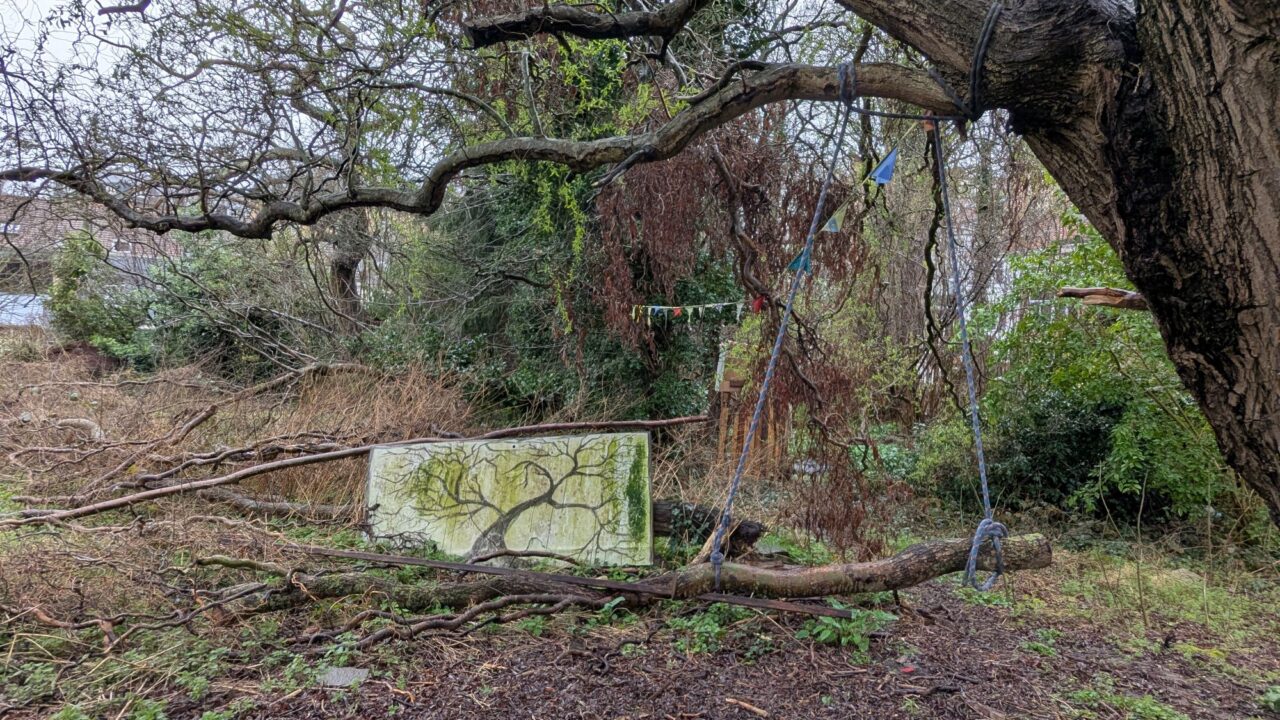
An ancient, beautiful forest filled with fireflies. Surrounded by fences and slowly rewilding. Humans are not supposed to go in, but some do. The neighbours of the forest asked for it not to be destroyed and built over, they managed to stop this process and yet, the place remains a point of friction and conflict, it is not accessible. Its future is uncertain, it is yet to be decided.
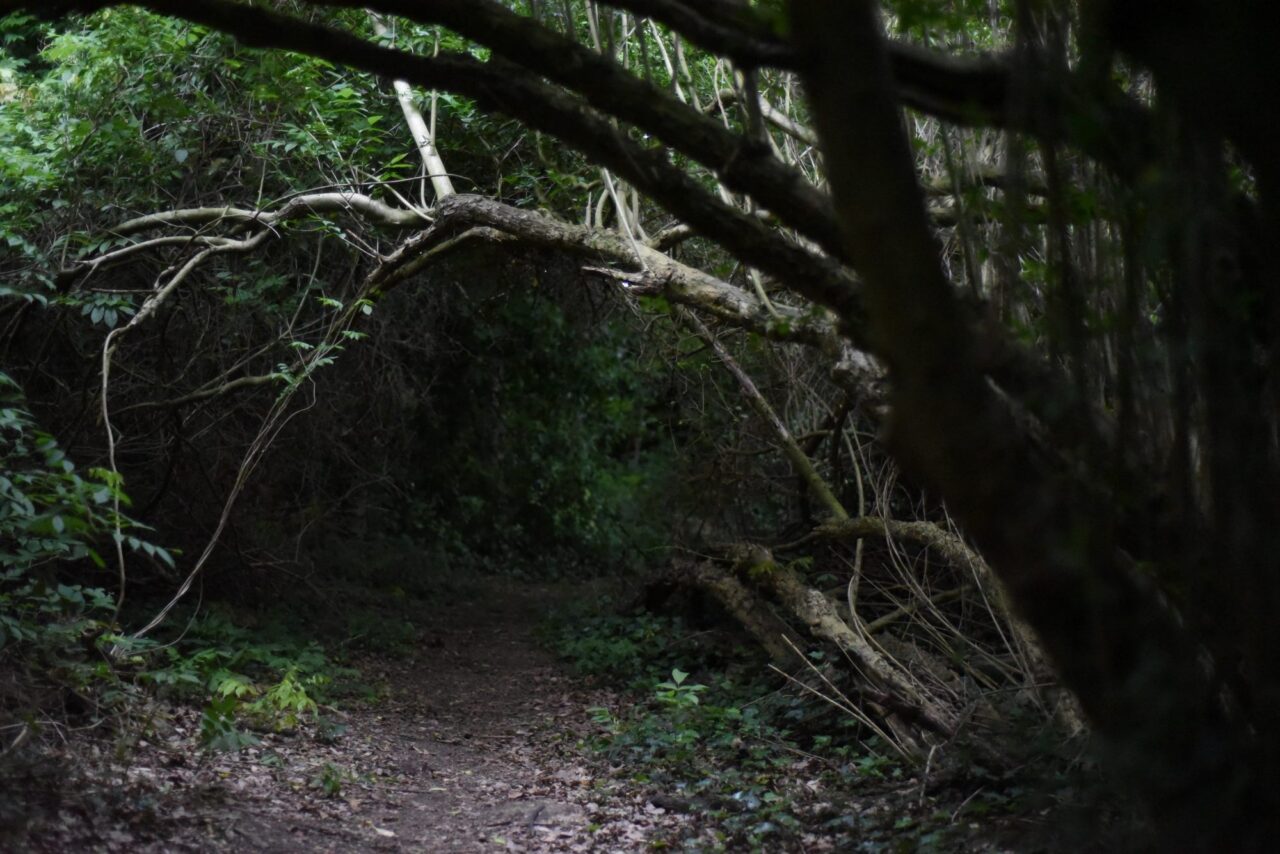
Vision 1: The forest of Donderberg in the year 2026
Viewer: Simon Asencio
At first sight the target seems like a forest, the architecture of a forest: the trunks and branches, the ribs of leaves. But the structure seems inorganic, like cold metal. It might seem like a recess, something that withdraws or gets hollower as one reaches the centre.
To the question “what is the function of the target?” the answer is, several things are underway, “ça trafique”, “ça administre”. Image of the European institutions, of Frankfurt, of slow ongoing administrative intelligence plotting a future.
To the question, how is the target when I put it in my hand, the answer is that it is very heavy, both materially and energetically. To the question, where do I put the target when unloading it from my hand, the answer is “avec les autres”. The target is located in an area along similar structures. However, the target seems to be directly surrounded by electric pillars or large fence poles. At the surface it is warm, at the core it is fresh.
The isolation or border between inside and outside is, however, what will lead the target to its own ruins.
Right now, the target is filled with heads, seen from the back. Presence of the ears. People gathered like in a concert. There is listening involved, sound but people are silent. The target seems to be a place for listening, reception or spying. Textiles cover some of the surfaces.
The firefly concert is over but she doesn’t want to stay for drinks, she walks away in the damp summer air of the night getting cooler, she goes to find her cabin. It’s been two months since the three of them turned their tent into something that can now be called a cabin. A shed, a tree house, might be better descriptions of it. When they arrived, they were told that they would be kicked out —the police come often and empty the park again and again; but somehow it has not happened in the past two months, so they stay. The guy from the neighbourhood association often comes, he doesn’t like that they live there, that they leave beer cans on the floor, he cares more for pigeons than humans and she understands, she doesn’t care for humans either, and that’s why she likes it here, but he should mind his own business and stop looking at her as if she was poisoning a lamb in front of his eyes when she throws a cigarette butt… they will clean up before they leave, if the police give them time… She doesn’t like that guy, but she loves it when the weird group of artists come and do shit like the “firefly concert”, or “listening to the bird languages”, they say they are not high but how could they come up with all of that, if not being constantly shit-faced? Anyways, they were kind enough and often brought beer with them, so she liked spending time with them. But tonight she did not want to, tonight she was on a mission to search for God, again. She told the cute boy with small hands to come around 11pm, she knows the others won’t be back in the cabin before way later, they will stay until there is no more beer or weed. She knows the boy’s hands are the path to God, this is why she stopped charging him money, they are small and they can go deep and she knows God is deep inside of her. The boy likes to wear that one yellow glove, the boy’s hand is His full hand inside of her, it tears open the cartilage of her pubic bones, reaching and spreading the door of her uterus as a reversed birth. But then what but a reverse birth is this wanting to reach God?
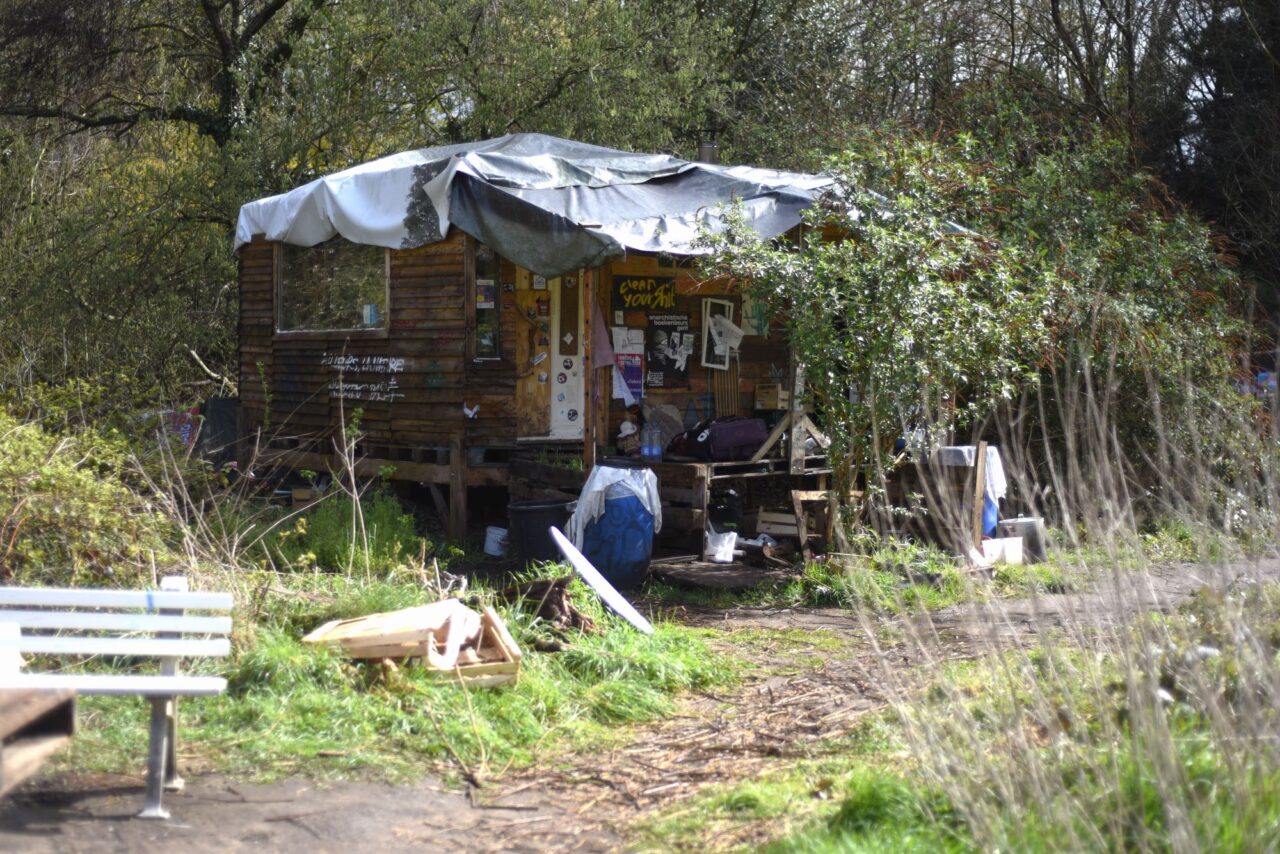
Vision 2: The forest of Donderberg in the year 2036
Viewer: Simon Ripoll-Hurier
The target doesn’t reveal itself clearly; it’s a complex place that resists. I don’t get any front-view image.
After a first impression of crispiness, like unstable dry mud in shades of brown, or the tops of trees of different colours, the target rather feels like a structure with repetitive patterns and diagonal lines. It is defined by a sense of speed, parallel bands, and a flickering effect.
Suddenly something trembles—the sensation of an earthquake shaking stones or tiles—something hard that threatens to revert to the session’s first impression of crispiness.
A round tube-like shape emerges, and with it a gaseous dynamic. The round shape thins out, flattens, and begins to move, like a wheel. It spins, alternately obscuring something with its blades or spikes.
Inside, it’s very intense—it’s as if I were inside the heart of a nuclear reactor, with water falling into a huge pipe. From above, I can spot a few small rectangular shapes—they could be buildings—but they’re as if camouflaged by a crackling form that’s interfering with the signal, jamming it.
Conflict over orientation, unsure of my ground. I’m pausing the session.
The next day, I resume work.
A gaseous dynamic gradually erodes a solid, heavy, inert dynamic. It is like a vortex, there’s no escaping it; it settles the score with everything.
What’s going on here?
Life is flowing. There’s a structured, or solid hole, traversed or joined by an axis that’s like a pedestrian path or a line of ants. The word “Svalakim” is perceived (after a quick search, it looks like a derived form of “sväko”, a Serbo-Croatian word meaning “everyone”)
That hammering noise again, metallic clashes. The image of a forge.
The session ends with this remark: somehow there is a scaling issue with this place.
He is tired. Tired of the pounding of the machine, tired of the smell of wet clay and tired of the darkness. When he built this tunnel five years ago, he never thought they would come and hammer right next to his head, I guess somebody from the commune’s government catched up with his idea of building under the ground. The forest had been abandoned since they tried to make some works in 2028 that then were aborted, or endlessly delayed. Common story in this city, so a lot like him came little by little to live here in tents. When the Summer of Fire of 2032 came, so many people who had apartments in the city came to sleep in the park, the only cool place in kilometres. When they started being too many, he decided to go live underground, it felt cool and damp, and nobody would bother him. He dug it little by little, first he opened a hole, and then a tunnel, and then the two tunnels of the right and the one on the left, so he could move a bit around without ever seeing other people.
Sometimes he wants to go out and see the sky, but it is too hot by day, and in the night it is when the forest gets the fullest. Sometimes people sleep on the entrances of his tunnels, if it is just one person, he comes closer and talks a bit to see if his voice is still the same after so much time speaking to no-one. One night he found this beautiful young man, reading a book with a flashlight, his big brown eyes seemed to be sucking the pages as two opened lips. When he came closer, he read aloud: La oscuridad de una cueva se asemeja a la del espacio, por eso en las cavernas están los primeros mapas que hicimos de las constelaciones[i]. Then he said it in English: “The darkness of a cave is similar to the one of outer space, that’s why in the caverns we find the first maps that we ever did of constellations”. He looked at the man’s hands: they were small and the thumb’s first phalange was shorter and wider than the others. He never saw the man again, but he often dreamed of his hands holding him. When he did, he woke up and saw stars in the roof of his tunnel.
[i] Monica Ojeda, “Chamanes eléctricos en la fiesta del sol”, English translation by myself.
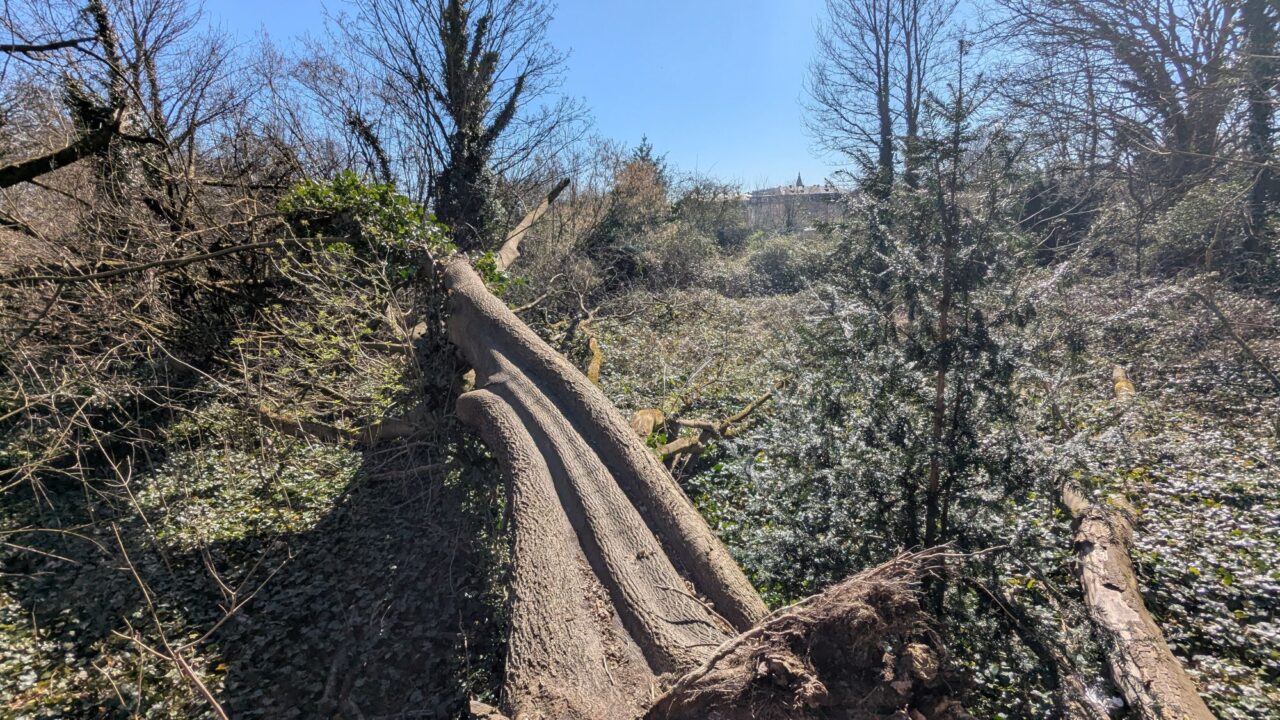
Vision 3: The forest of Donderberg in the year 2056
Viewer: René Huari Matteus
The target is divided into three chambers, each with its own way of existing.
The first one is exposed, almost reduced to its basic elements. There is a horizon, almost insistent, and everything seems stretched bare beneath it. Somewhere there is the metallic click of cutlery being sorted, very far away. Sound seems to get lost there. An echo starts, but instead of coming back clearly, it drifts further away, gets thinner, until one is not sure whether one still hears it or only remembers it.
There is almost nothing blocking the view. Pale whores appear for a moment, enjoying themselves, then disappear again. Like spectres. They keep the place somehow alive, although maybe they are not really there, or maybe they were there once. Maybe they exist only as projections, produced somewhere between the person looking and the horizon. Like a mirage in the desert, when something appears in the distance and for a moment one is convinced there is water there.
The second chamber is much denser. Things happen too close to each other. Bodies pass, stop, turn around and disappear behind objects.
There are signs, entrances, lights, voices, screens. A yellow glove lies on the floor. Somewhere a printer keeps producing blank paper. Three oranges roll slowly against a wall. There is a small aquarium with no fish in it, a chair that looks like it belongs in a dentist’s office, and something wrapped in silver foil. A child’s raincoat hangs from a railing. Every few minutes a soft bell rings, but nobody seems to react to it. Something is always blinking somewhere. The eye keeps hitting things.
People seem to move according to patterns they probably do not notice themselves. They wait, cross, hesitate, accelerate. Sometimes several bodies suddenly move in the same direction and for a few seconds the whole place seems organised. Then it falls apart again.
Shoes against the floor. A door opening. A voice coming through a speaker. The voice is antipolice, or speaks about antipolice, or antipolicing, about the possibility of a place where nobody is told to lower their voice, where everybody could laugh too loudly, where antipolicing is there to encourage the laughter to become louder and louder. Somebody does. For much too long.
The third chamber is much harder to describe.
The floor is, in some places, extremely hard to chew. There is a long table covered with small ceramic animals, most of them facing the same direction. Everyone asks about them, but nobody knows who arranged them that way, or when.
The air is humid. Water is dripping, but nothing on the floor is wet yet. It is coming.
A reflective surface rises vertically through the room and continues beyond the ceiling, maybe all the way to the stratosphere. Looking into it does not always produce a reflection. Sometimes there is only light. Sometimes there is a room that looks almost identical to this one but has one more window.
A crow flies vertically through the room, against all the laws of nature. Or maybe it is a raven. It moves too fast to determine. It lands on the table, walks between the ceramic animals and leaves again.
Up, up, up.
Every seventeen seconds, a woman is sleeping on a pile of folded towels. She sleeps for two and a half seconds. When she wakes up, two lamps switch on automatically.
The three chambers are spiced with quantum entangled particles, and that means we cannot pretend that what happens in one of them stays there. Distance no longer guarantees separation. It is something like a butterfly effect with immediate verification: a movement in one chamber produces a corresponding change in another, without a visible chain of causes travelling between them. A body turns here, a light comes on there, and suddenly both events belong to the same field. No distance can absolve one space from what is happening in another.
Across all three chambers, the same sentence is written: Is this the condition we are being asked to understand?
They found hundreds of these pages spread on the floor of the cavern, somebody from the past had described them perfectly, the three whores, the three spectres, the three mirages. And somebody seemed to be able to see this space, the abandonment, the ceramic figurines… It’s always nice to feel seen, even by an invisible author that seems to have forgotten these pages.
Travelling through time has never been an extravagant idea to her. When they left the forest back in 2028, they were young, they were happy (although they did not know it then), they were alive. They went away when the machines entered and started pouring concrete on the soil, making paths for runners to run, for strollers with babies to pass, turning an abandoned forest into a chewable forest for urbanites. The three of them left, they didn’t even care for that place back then, they did not know they were happy there. They did not feel they belonged; they did not want to fight for that place. They were not from there, they were not even welcomed, so why should they defend that soil, those trees? They would travel and go to the next place as they had been doing for so many years.
It is only today, after almost 30 years of living through the life that the future had in store for them, after having met God in so many humans, that they had returned. She knows now that there is no such thing as belonging to a place, she knows you simply belong to earth, when you are earthbound then you need to defend every piece of it, whether the humans there make you feel welcome or not.
After 30 years of fighting, they somehow got nostalgic, so they came back. Some of them were not alive, some were, she wasn’t really sure which one of them was or wasn’t, it seemed to change from day to day, so she didn’t care. She often thought she was the ghost. A ghost is the opposite of an angel. A ghost carries residue or after-image of its earthly existence. It’s like a leaden emotion, laden with recollection. An angel has never experienced the earth as a sensual event, even though it may aspire to; a ghost yearns away from the object the angel envies[i].
When she realized that she yearns more for the life she had back then, than for the love of God, she stopped looking for God in the fists and hands of her clients or lovers. And then she stopped fucking, because why would she do that if it was not to find God? It had been years now, some of the others who were not dead, or when they were not dead, kept telling her that she was still young to stop having sex, that she should make an effort, how else were they going to get food? But the bodies that came looking for her would disappear like thin air between her fingers, sbricciolandosi fra le dita, like bread… they did not exist, or maybe she didn’t… anyhow, there could not be any fucking done like that.
She now just spent the whole day waiting for the pool to be filled by the rain and the little streams. She took care of bringing the towels for the three of them, for the ones who were alive that day, since the dead ones didn’t care for entering the water.
When the water comes, she knows she is alive. And there is nothing like the watery element to unleash such an attention, this eagerness to listen and this unformulated hope that the waters —especially the unfathomable and the secluded ones, that never pour themselves in the stream or the source that always has a song— may come to suggest something…[ii] The waters were filled with memories, like quantum particles she could time-travel thanks to them. Perhaps it was some form of pollution in the water, she didn’t remember if water had always been such a vector for memories before the rains were this polluted, but she knew now it was.
She dives deep. Under the water she doesn’t need to know what is dream, what is memory, what is now. She can simply dive and listen.
[i] Fanny Howe, “Saving history”
[ii] “Y nada hay como el elemento acuoso para desatar esta atención, ese ansia de escuchar y esta esperanza informulada de que las aguas- y más todavía las insondables y recónditas, las que no se vierten en el arroyo o en la fuente que tiene siempre su canción- lleguen a sugerir algo.” Maria Zambrano, “Claros del bosque”, English translation by myself.