Developed by: students of Vrije Universiteit Brussel (VUB) Sien De Groote, Mai Pluymers, Kat De Wilde, Emma Gysen en Oscar Loomans as part of the ‘Case Studies’ course, 3rd year of the Bachelor’s program in Social Work, led by the teaching team of E. Crois & F. De Backer
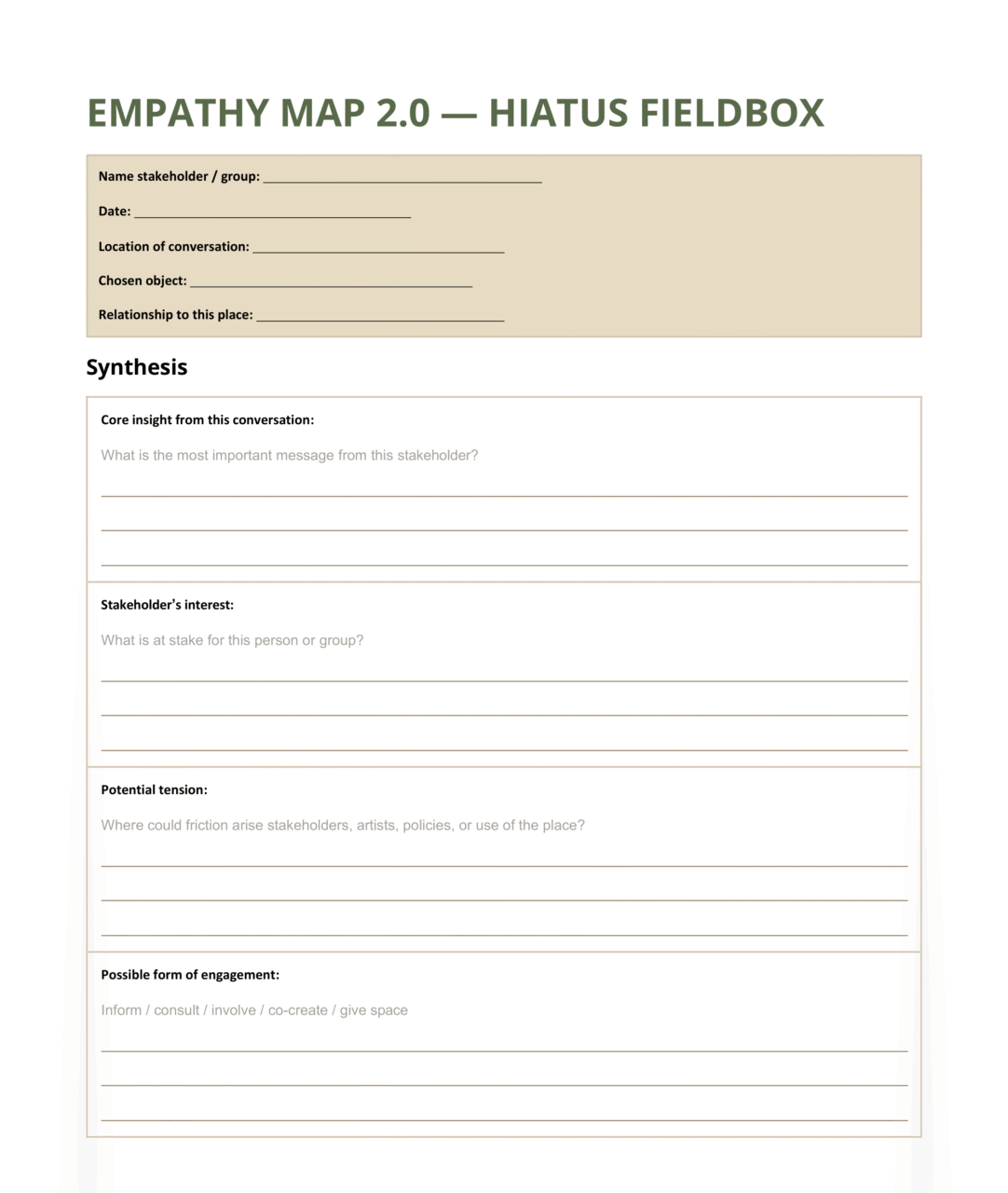
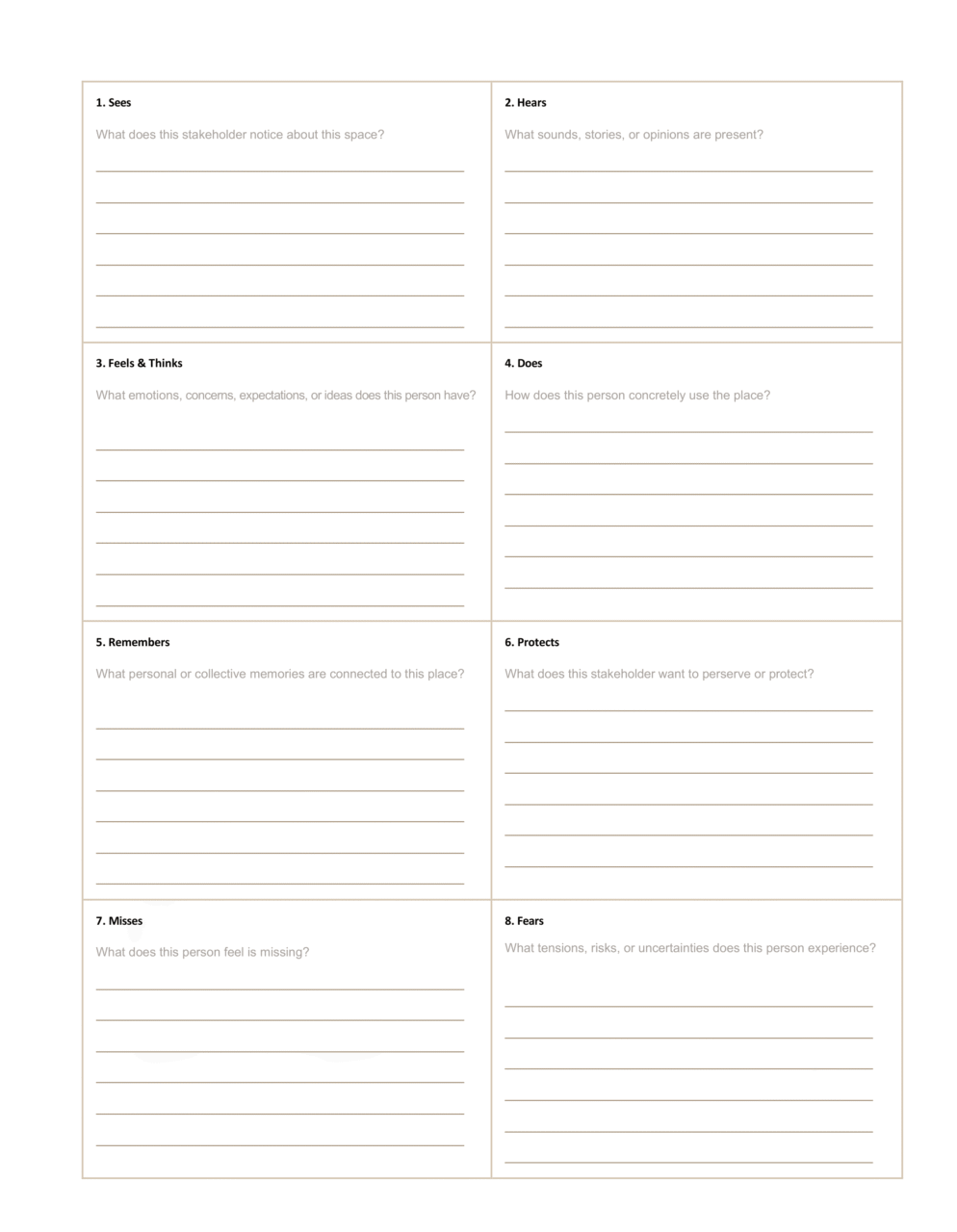
The Empathy Map is a structured tool developed by students of the Vrije Universiteit Brussel (VUB) as part of the Hiatus Fieldbox. It is designed to help artists, particularly those working in green or public spaces, capture and understand the experiences, emotions, concerns, and meanings that stakeholders associate with a specific place.
Unlike traditional research methods that rely solely on rational questions, the Empathy Map incorporates sensory experiences, objects, and symbolic connections to the location. It transforms a physical space into a social, emotional, and symbolic landscape, revealing deeper insights into how people perceive, use, and value the area. This tool is especially useful for artists aiming to engage meaningfully with communities and translate their findings into creative or participatory projects.
The Empathy Map is one component of the broader Hiatus Fieldbox, which includes additional steps like tension mapping, engagement matrices, and reflection cards to ensure a holistic understanding of stakeholders’ relationships with the space.
Choose an object or starting point
Ask the stakeholder to select an object or element from the environment, such as a leaf, branch, stone, bark, photo, sound, smell, or other place-specific item. The object serves as a conversation starter, making the discussion less formal and more connected to the place.
Ask questtions
to open the conversation. The artist does not need to ask all the questions or follow a fixed order. The cards serve as a guide to explore themes such as:
Seeing
What do you notice when you are here?
What attracts your attention?
What is here others might not notice?
Hearing
What do you hear when you are hera?
What sounds are typical for this place?
What stories or opinions have your heard about this place?
What voices are not enough heard?
Feeling
How would you discribe the atmosphere of this place?
Do you feel welcome, at ease, free?
What concerns of hopes do you have for this place?
Doing
What do you do when you are here?
Do you visit by yourself or with others?
Are there situations when you use the place differently?
Remembering
Can you remember something you experienced here?
What story or history is important for you?
Has this place changed since you know it?
Meaning
What is the importance of this place for you?
What makes it different?
What can get lost if this place changes?
Protecting
What elements or aspects should stay?
What makes this place valuable?
Who or what needs protection?
Missing
What could make this place better?
What are its needs?
What could help you to get (more) involved?
Fearing
What tension can feel around this place?
What can go wrong?
What are the sensitivities of or about this place?
Changing
What changes would be positive?
What changes would you avoid?
Who should have a say?
Involving
On what level do you want to be involved: being informed, giving your opinion, think along or create?
What do you need to get involved?
What is important to know before starteing a project here?