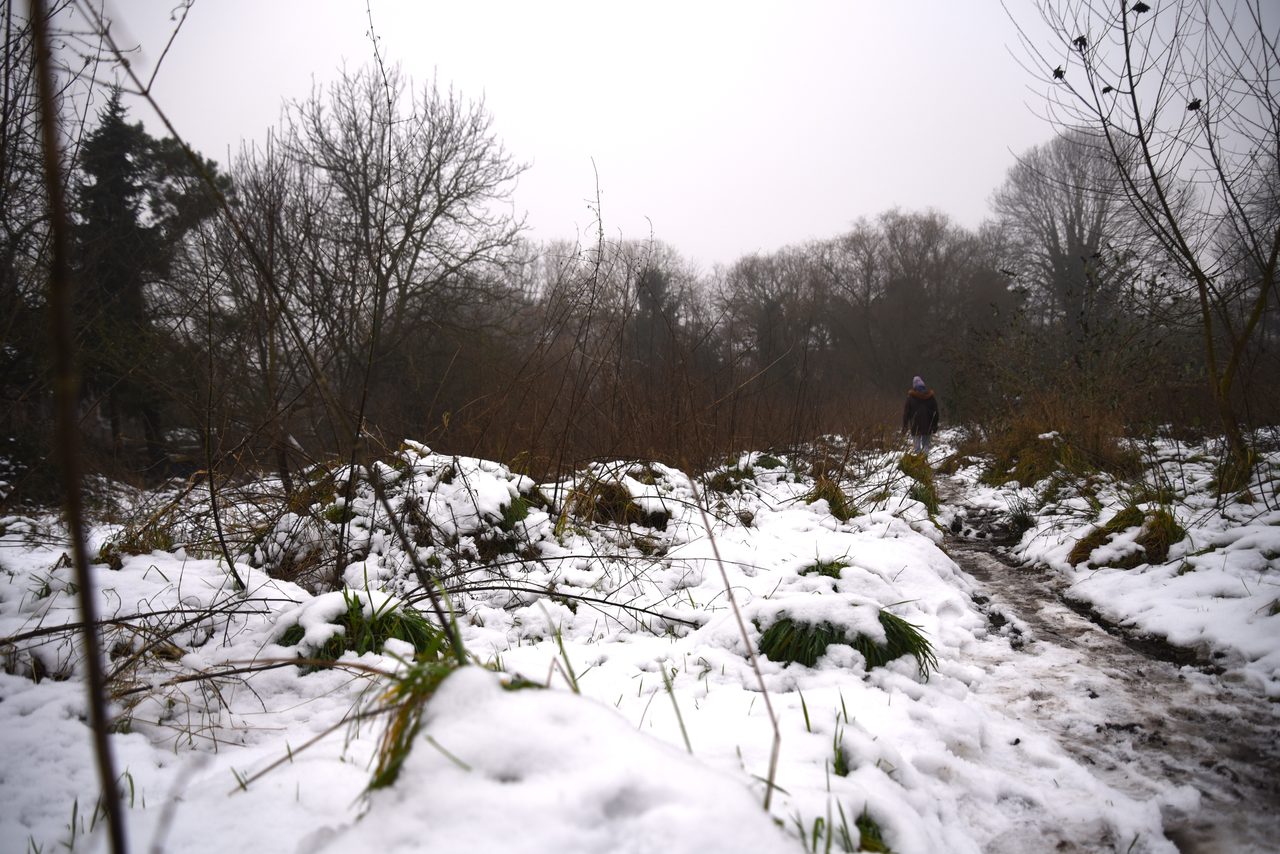
By Allan Lee Wei
Historically the word commons designated plots of earth surface – woodlands, pastures, waterbodies, marshes and fens – together with their human and non-human components. In those places uses and enjoyment were not reserved to a single social actor, commons designated the juridical rights attached to these forms of non-exclusive possessions : contrarely to the modern notion of property those traditional rights were not exclusively reserved to a private owner. Commons were not labelled as such by state law but by de facto use, it was a law generated by daily customs, by the effective practices of social groups, a situation of consuetudino recognized a posteriori by legal institutions (Gutwirth, 2022). Commons are thus both material (terrestrial commons) and symbolic/ ideological (common law) (Wei, 2026). From the place that occupies us – contemporary wastelands in urban environment – the french word friche comes from the medieval netherlands virsch lant, thus a fresh new land. Originally, it was a word used by early agro-industrial entrepreneurs to disqualify the previous popular uses on commons, to label those places as blank pages, available for development and value generation, as if the previous uses had not designed the landscape through the practices attached to it.
Donderberg (3ha) was part of the Domaine Royal, the 176 hectares exclusively reserved to the pleasure of the Crown founded at the end of eighteenth century which is still today the largest fenced green area in the north-western part of Brussels, popular neighbourhoods where green open spaces are desperately lacking in a context of intensifying heatwaves and housing crisis. Donderberg (mount of thunder in flemish) was the part of the Domaine Royal that hosted the pépinière, a botanical nursery and place of acclimatation for exotic plants that were then planted for the pleasure of the royal eyes and their hosts. It is thus a place devoted to care and control of the multispecific composition that was considered adequate for the social classes, aristocracy and bourgeoisie, that enjoyed the work of gardeners and plants. This care and control was centralized and aesthetized, it had no practical value except the aesthetic coherence that was expected and experimented.
Since 1969, Donderberg was abandonned, the horticultural and botanical landscape was left to itself and to the numerous contaminations and resurgences of previous agricultural landscapes (Tsing, 2018). This abandonment produced a singular composition, that generated a high biological and ecological value in an urban european context, it is thus neither a wasteland, neither a friche, but a unique biotope (living place), it is not a blank page but a common poem currently written. However, the new values that emerged from the anthropic perturbation and the multispecific regeneration are constantly in balance with the important socio-economic value that this surface of land represents in a metropolitan city as Brussels, in a context of demographic expansion and real estate speculation. The regional center-right governement recently announced that along with two other friches (Marais Wiels and Plateau Avijl), Donderberg will be saved and sanctuarized. This apparently good news must be analyzed in the broader picture of regional land-use, as it raises new questions about the desirable and possible futures of what can be considered as a contemporary common.
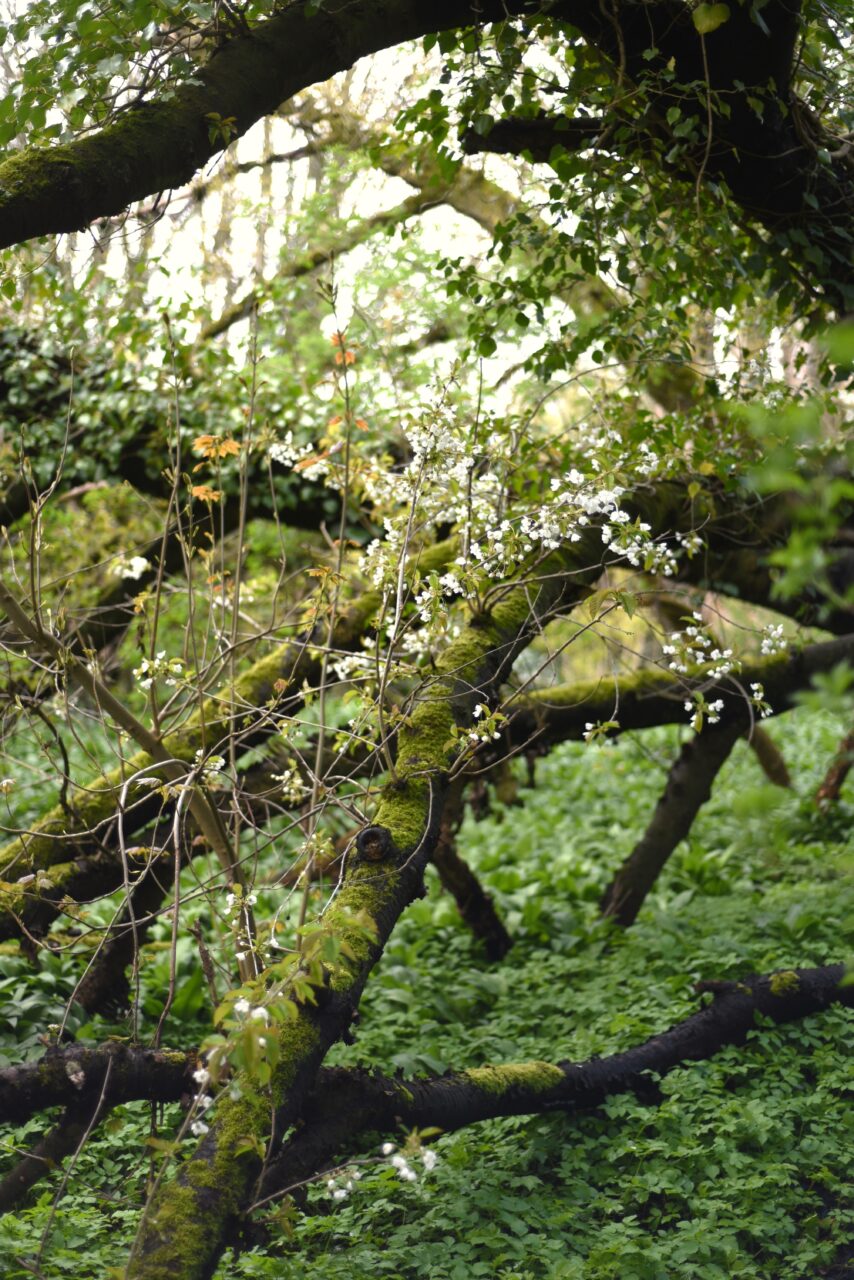
Photo: Hans Ruebens
From the local point of view, the major questions are how to safeguard, defend, let persist and accompany the resurgence that has taken place both in its social and biological diversity. In that sense, the notion of wilderness does not really help us to adjust our practices to the actual and future situation. As the short historical introduction outlined, far from beeing wild, Donderberg is a stochastic composition of social and natural history, a refuge for feral inclinations (Tsing, 2025). This does not undervalue the richness of the spontaneous “nature” that redesigned the abandoned landscape : the importance of such urban refuges has been stressed by entomological and aviary research. While agriculture, logistic and urban sprawl are desertifying rural areas, metropolitan areas that concentrates human population represent an increasing share of biodiversity (depending on the scale on which available datas are analyzed). As urban areas are not valued following their agro-industrial potential ; pesticides have been banned since 2013 in Brussels, fostering an increase in non-domestic pollinators (Vereecken & al., 2021) and other insects such as fireflies ; on the other hand animals considered as nuisible in agricultural context such as foxes or some rodents (lérots), are considered as precious and cute biological heritage for the city. We are only beginning to understand this new situation and the transformation it is generating both in the genetic composition of those species and in their specific culture. As a recent thesis on urban foxes in Brussels outlined, the sociality of the group and families observed for 4 years is much more complex than what was known in the state of the art. With greater food disponibility and less dangers (human and non-human predation and extermination), foxes found more stable, numerous and complex communities (Namias Vanden Berghe, 2025 & 2026). Underlying the free evolution notion is the modern concept of freedom, thus the idea that anybody can make everything it desires, wherever and whenever it wants. On the contrary, the observations lead us to co-evolution, thus the intertwined and reciprocal actions of socially various human actors and biologically various animal, plants, fungi and mineral agents. Rather than freedom, this bring us to practice autonomy, thus the limited freedom to collectively define to which attachments we wish to rely, on which limited dependencies we consent, the ties that free us. Co-evolution could lead us to shift from an ecosystemic point of view to some kind of new cultural paradigm, which Felix Guattari labelled as ecosophy (Guattari, 1989).
This philosophical framework is more important than it seems : places such as Donderberg should not only be valued for the ecosystemic services they provide – refreshment, mental health ecological education and training, biodiversity hosting – it is not only an element of socio-ecological welfare, an essential non-electric fan in a context of urban climatic stress. While the regional land use plan (Perspective, 2001) is undergoing revision ; practices and knowledges experimented on singular places as Donderberg, can invite us to adjust the state-backed institution of functionnal urbanism which assigns an exclusive use to each plot of privately owned-land.
We should consider the potential of prefiguration, the means of visualization for other possible, desirable and absolutely necessary worlds : eventually post-capitalist futures (Cirillo & al., 2026). The place let us thus breath together, litteraly conspire, cum spirare. On these premises, our attention can then be attracted by new set of values and rules necessary to the common enjoyment of a patch of land we are part of. In that sense, rules are expressions of the reciprocally non-exclusive needs, inclinations and preferences of all the components of the milieu, an assemblage of Umwelts. As the geographer Elisée Reclus once wrote, anarchy is the highest expression of order (Reclus, 2019, éd.originale 1898) : the punkanarchic aesthetic (Lenoir, 2018) generated by the multiple social and biological bodies that occupy and possess places such as Donderberg, is a powerful attractor to unleash bodily senses that have been channeled by modern urbanism. The tension between communization of place and emancipation from centralized care (pastoralism) is the (h)eart(h) of a democratic conspiracy to outline the future of singular places. How should a fluid, temporary and hybrid We define possible uses and practices on a singular place in line with the conditions and dependencies necessary to the persistance of the experimental composition ? How to design paths from landscape to livingscape, from metrical space to patchy places, from ecosystem to forms of lifes ?
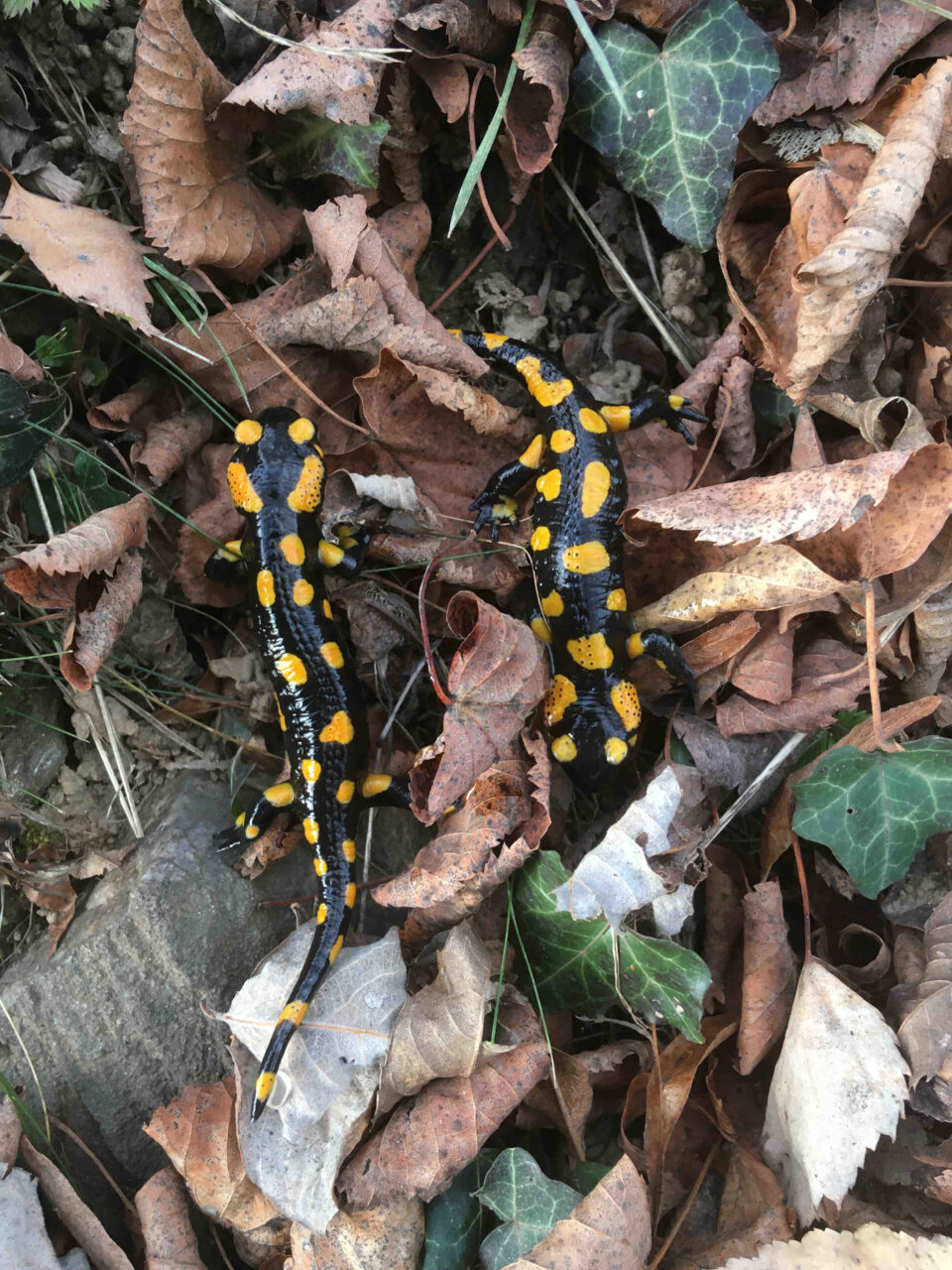
Salamandre Salamandre,Piemonte, novembre 2025, crédits : Allan Wei
To open up the apparent conclusion of the recent history of this particular wasteland in Brussels, from the neighbours collective Save Donderberg to the occupation and shelters construction by the radical collective Donderberg Sauvage, from the managers of the municipal agency Régie foncière de la ville de Bruxelles to the gardeners of the division Espaces verts de la de la Ville de Bruxelles, a few point of attentions must be outlined on a pragmatic level :
- Depart from expected and exclusive uses of “nature” such as public garden or wildlife reserve. Abandonning the ideology of a fixed state of reference doesn’t mean to erase the remarkable trees or the discreet species present but rather to maintain the ecotone, e.a. the transition from the shadowy forest biotope to sunny grassland biotope, which forms the hospitable border, suitable for the most diverse number of species. In order to achieve its major goals without condemning struggling minor desires, conservation sciences should take in account subaltern aspirations. From a anthropic point of view – building shelters for persons in need of a refuge, erecting temporary tents linked to the existing trees to assemble collectively protected from harsh sun, digging small water basin to accumulate rain water and refresh feet and bodies during the hottest months, gardening a shrubbery for the pleasure of the hands and senses of neighbours and pollinators, caring for a fire to prepare a meal (commensality) particularly when the atmosphere needs to be heaten up – are all popular practices that are more than welcome to the practice of commoning, as long as they do intertwin and respect the most sensitive areas and moments which are often unexpected, as amateur and academic naturalists well know.
- maintain and entertain as multispecific commons the ecotone and the paths that allow us to reach, go through and discover the place (Stengers & al., 2022), this means to celebrate moments to repair the gates, mow the grassland, reinforce the paths, define the limits between private gardens and the common. This ecological management, or rather these ecopolitics, should be (s)low-tech, re-enacting traditionnal gestures and tools, re-discovering or inventing collective songs and dances, to allow species to depart from the specific area during those seasonnal moment and to allow the participants to encounter themselves and the other participants, not by mimicrying or mocking bodily enactement but to link them with effective socio-ecological practices not centered on the individual mental health but on a coming together. Those moments should not cost fossile fuel and materials, public money or political authority, but will certainly cost cruel dilemmas and patient consensus-making, unending discussions and irreconciliable separations : a fierce attachment to the common nature of an ongoing experience.
- design a legal status that recognizes co-decision and co-possession : assembling occupants (would they be human or non-human), neighbours, local naturalist association (Natagora), municipal level workers (Espaces verts de la Ville de Bruxelles), regional level environment administration (Bruxelles Environnement). As proposed in the legal ecological litterature, this status may take the form of a moral personnality for Donderberg, not to designate representants or mandataires for the entity and its components, but rather to provide an institutionnal framework, a democratic arena to produce decisions closest to the place, decisions that will and must be challenged by the past, present and futur commoners.
References
Bastin, Scohier & Wei (2025), De l’îlot Shell au Marais Biestebroeck, Bruxelles en mouvement, 339, p.9-11, [En ligne : https://www.ieb.be/De-l-ilot-Shell-au-Marais-Biestebroeck]
Cirillo, Deligne, Namias Vanden Berghe & Wei (2026), Milieux de vie, in Baschet & Jeanpierre (Eds.), Mondes postcapitalistes, La Découverte
Guattari (1989), Les Trois Écologies, Galilée
Gutwirth (2022), Les communs : avec, malgré ou contre le droit ?, Journal des tribunaux, n°6913, p.582-594 [En ligne : https://jt.larcier-intersentia.be/publications/jt_2022-fr/jt_2022_33- fr/jt2022_33p582
Lenoir (2018), Petit traité du jardin punk. Apprendre à désapprendre, Terre Vivante
Namias Vanden Berghe (2025), Meeting Tobbie: Beastly Stories About Urban Red Foxes – A Case of Infanticide, Society & animals, 1, p.1–17, [En ligne : http://hdl.handle.net/2013/ULB-DIPOT:oai:dipot.ulb.ac.be:2013/408501]
Namias Vanden Berghe (2026), Des crocs, des cris, des mots. Histoires bestiales de renards à Bruxelles (Unpublished doctoral dissertation). Université libre de Bruxelles, Faculté de Philosophie et Sciences sociales – Sciences politiques et sociales, Bruxelles.
Oouassak (dir.), Ajari, Bahaffou, Boukari, Escobar, Ferdinand, Kisukidi, Mihindou, Sheikh, Alsoumi, collectif Vietnam Dioxin, association A4, (2025), Terres et liberté: Manifeste antiraciste pour une écologie de la libération, Les Liens qui libèrent
Perspective, regional administration for territorial development (2001), Plan Regional d’Affectation du Sol (PRAS), https://gis.urban.brussels/brugis/#/
Reclus (2019, éd.originale 1898), L’évolution, la révolution et l’idéal anarchique, Lux éditeur
Stengers, Wei, Gutwirth, Grégoire, Prignot, Stroobants, Wallenborn (2022), Les chemins vicinaux du Donderberg des communs urbains multispécifiques supprimés dans l’indifférence ?, Le Soir, carte blanche, 2022.12.22 [En ligne : https://difusion.ulb.ac.be/vufind/Record/ULB-DIPOT:oai:dipot.ulb.ac.be:2013/368398/Holdings]
Tsing (2018), Holocene Resurgence Against Anthropocene Plantation, Multitudes, 72(3), p.77-85, [En ligne : https://doi.org/10.3917/mult.072.0077]
Tsing (2025), Atlas féral. Histoires vraies et proliférantes des résistances aux infrastructures humaines, Wildproject
Vereecken, Weekers, Marshall, D’Haeseleer, Cuypers, Pauly, Pasau, Leclercq, Tshibungu, Molenberg, De Greef (2021), Five Years of Citizen Science and Standardised Field Surveys in an Informal Urban Green Space Reveal a Threatened Eden for Wild Bees in Brussels, Belgium, Insect Conservation and Diversity, vol.14, issue 6, p.868-876, [En ligne : https://difusion.ulb.ac.be/vufind/Record/ULB-DIPOT:oai:dipot.ulb.ac.be:2013/333077/Holdings]
Wei (2026), Classes, droit et milieux de vie. Une relecture écologique du vol de bois chez Marx, Vertigo, [En ligne : https://journals.openedition.org/vertigo/55965]
Author
Allan Lee Wei
Historian and geographer, researcher in urban ecology at the Université Libre de Bruxelles, Allan Wei studies wastelands, with a particular focus on resurgent wetlands in urban areas. A co-founder of the associative booksshop Par Chemins et Ruines in Forest (https://www.librairie-par-chemins.be/), he has recently been following some trails of the italian Alps. He has recently received a Phd scholarship, financed by FNRS (Belgium), on the theme “ Ecologisation of urban planning and resurgence of wetlands in Turin (Piedmont)”.